Northern Lights in Finland: Where and When to See Them
Where to see the northern lights in Finland: FMI odds by place, the best months and hours, how to read the forecast, and what a tour adds.
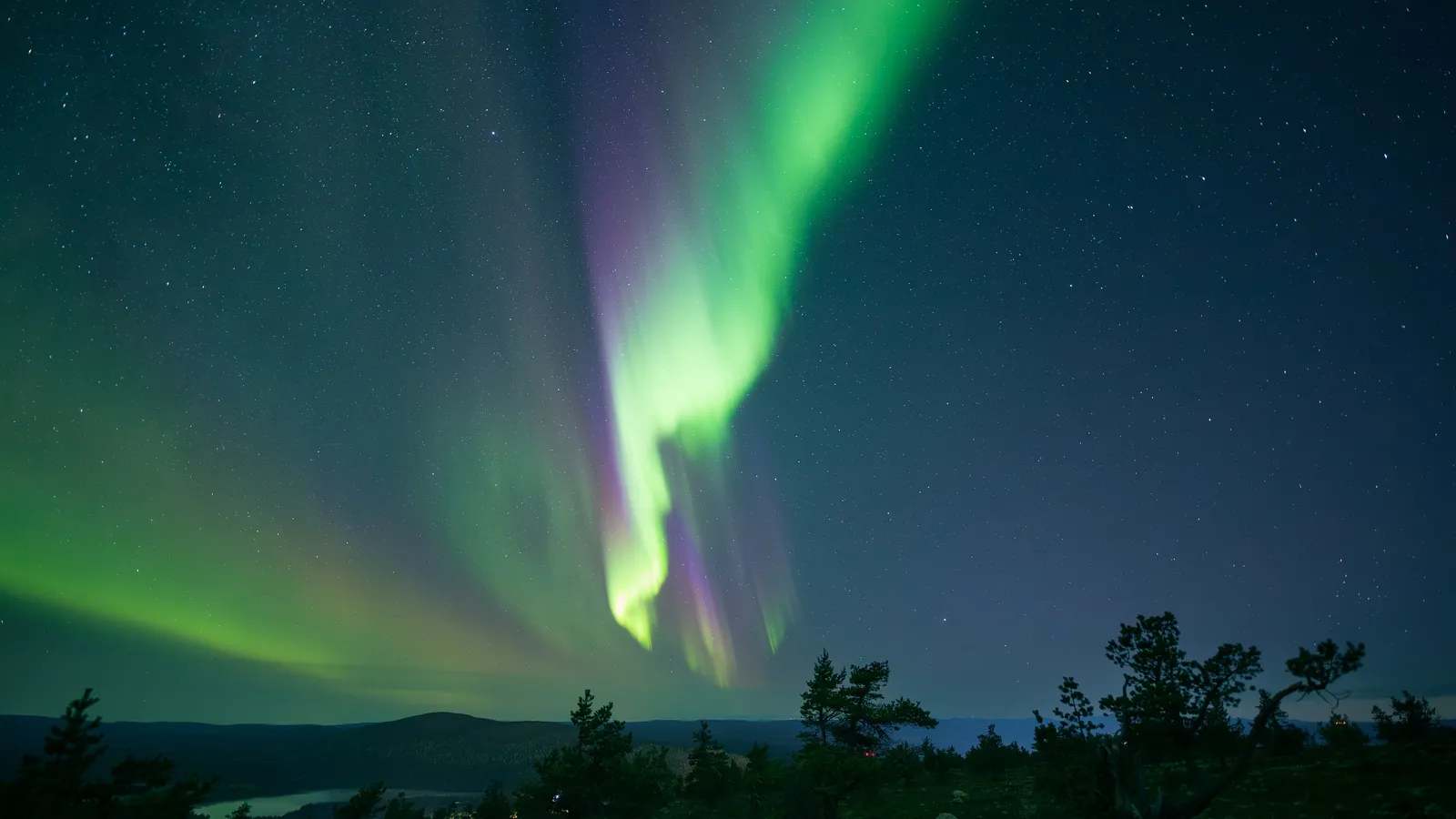
You can see the northern lights across Finland’s north from late August to early April, and the odds are best in Lapland. The Finnish Meteorological Institute (FMI) puts the chance at about 50% of nights in Lapland ski resorts such as Ylläs, Levi and Saariselkä, and about 75% at Kilpisjärvi, on nights that are dark and cloudless. Those last two words matter most: if it’s cloudy, the aurora can be overhead and you won’t see a thing. This guide is about stacking the odds for the 2026-27 season, so you see the lights on at least one night of your trip.
Where in Finland the odds are best
The further north you go in Finland, the better the statistics. These FMI figures are for dark, cloud-free nights:
| Area | Chance on a dark, clear night (FMI) |
|---|---|
| Kilpisjärvi | About 75% of nights |
| Lapland resorts (Ylläs, Levi, Saariselkä) | Roughly 50% of nights |
| Central Finland (Oulu, Kuusamo) | Roughly 25% of nights |
| South coast (Helsinki, Turku) | About once a month on average |
The table ranks places; it doesn’t promise a show. These are long-term averages, so they describe odds over many nights, not a forecast for any single evening, and they say nothing about cloud. A 50% night in Levi with solid cloud is a zero. What the numbers do tell you is that a base in Lapland gives you several chances in a week, and a base in Helsinki gives you almost none, unless a geomagnetic storm pushes the oval south.
Which resort? For most first-time visitors the choice is about logistics rather than aurora odds. Rovaniemi, the regional capital, has an airport and the night train from Helsinki, and the Finnish Lapland guide compares it with the ski resorts as a base. Levi and Ylläs share a similar rate according to FMI’s statistics, so choose by ski slopes, restaurants and flights. Saariselkä and Inari, in the north-east, are covered in the Northern Lapland and Inari guide. Kilpisjärvi, in the far north-west, carries the 75% figure, but it’s a long way from everything and suits a second trip or a dedicated aurora week.
Within each place, darkness matters more than distance. Visit Finland points out that even Rovaniemi has dark skies a short way out of town, and that open ground such as a frozen lake or a fell gives the clearest view. If you’re staying in a town, a short drive or guided trip beyond the street lights does more than any forecast.
When to go: season, month, hour
The aurora itself occurs all year, but it’s only visible when it’s dark. Visit Finland gives the season as late August to early April, with the busiest travel month being December. FMI adds that activity is slightly higher in spring and autumn than in winter or summer, and that the best months are February-March and September-October.
With the weather counted in, FMI’s pick for the north is March and early April. If your dates are flexible, early March has a better claim than Christmas on the lights alone, though not on Christmas atmosphere.
| Period | What to expect |
|---|---|
| Late August to September | Season opens as the nights get dark again; September is one of FMI’s best months |
| October to November | October is still one of FMI’s best months; the nights keep lengthening |
| December to January | Long dark hours; most popular travel time |
| February to March | Long nights, activity rising again |
| Early April | Season closing; chances drop significantly by mid-April |
Time of night: FMI says the typical display is around midnight and a couple of hours either side, and names 9 p.m. to 1 a.m. local time as the window to aim for. That’s useful if you’re picking between a 7 p.m. tour that ends early and a late departure.
Solar activity has a long cycle too. FMI notes that large displays follow the 11-year sunspot cycle with a lag of a couple of years, and that this matters most in southern Finland; in Lapland, auroras are common even at solar minimum. So the cycle shouldn’t decide your booking date if you’re going north.
How to read the forecast
Two things have to line up: the sky has to be clear, and the geomagnetic field has to be disturbed. Check both.
Cloud. Use the FMI weather forecast for your location. The Visit Finland guide calls clear skies the single biggest factor. If your resort is under cloud, the answer may be a drive to a clearer patch, which is where a guide with local knowledge earns the fee.
Geomagnetic activity. FMI’s “Auroras and space weather” page shows the R-index from its magnetometer stations over the last 24 hours. Each station has two thresholds: when the lower one is crossed, auroras are possible but usually dim, and the bars turn yellow; when the upper one is crossed, auroras are very likely, and the bars turn red. It’s a live read of what is happening, rather than a forecast days ahead. Visit Finland also explains the Kp index, which runs from 0 to 9: a reading of 1-2 may be enough in northern Lapland, while higher readings reach further south.
The practical routine: check the cloud forecast in the afternoon, check the FMI page in the evening, and stay flexible. An alert isn’t a guarantee, and on a quiet night you can still see a faint green arc if the sky is dark.
What a tour adds
You don’t need a tour to see the lights. You do need a dark spot, warm clothes and patience; Visit Finland’s own advice is dark, clear skies, patience and warm clothing, especially for the feet. The layers for a -20 °C night are in Finland before you go. A tour adds three things: transport to a darker place, a guide who watches the cloud and moves the group, and something to do while you wait. Visit Finland’s listing includes snowmobile and electric-sled safaris, reindeer and sledging evenings, aurora skating, photography tours and sauna or hot tub evenings.
Prices vary a lot by operator, group size and date, so compare two or three operators’ own pages for your dates. Two things to check before you book: whether you can move the date if it clouds over, and whether transport from your hotel is included. If you’re building a longer trip, the five-day winter route leaves evenings free for this, and Santa Claus Village is a daytime stop that doesn’t clash with a night out.
One tip counts for more than the choice of operator: book your aurora evening for the first or second night of a stay, and keep the last one spare. If the sky is cloudy, you get a second go.
Photographing the lights
Visit Finland says you need no special equipment to see them. For pictures, it suggests a tripod and a camera or phone set to night mode, which may capture more than your eyes do. A few extras: keep spare batteries inside your coat, since cold batteries tire quickly, and give your eyes time to adjust before you judge the sky.
The short plan
- Fly to or base yourself in Lapland; southern Finland offers few chances.
- Choose March if you have a choice; September-October if you want the autumn equinox.
- Allow several nights, with an aurora evening early in the stay.
- Watch cloud first, then the FMI space-weather page.
- Get away from street lights, by tour or by yourself.
Photos
Read also

Things to do · 8 min read
Lapland Winter Safaris from Rovaniemi: Prices and Ages
Updated · 17 November 2026Husky, reindeer and snowmobile safaris from Rovaniemi in winter 2026-27: operator prices, ages, the licence rule, clothing and weather cancellations.

Before you go · 7 min read
Finland Before You Go: Entry Rules, Light and Cold
Updated · 17 November 2026Visa-free 90 days for US, UK, Canadian and Australian passports, EES and ETIAS in November 2026, daylight and monthly temperatures, and winter kit.

Transport · 10 min read
Helsinki to Lapland: Night Train, Day Train or Flight
Updated · 17 November 2026Helsinki to Rovaniemi by VR night train, day train or Finnair: winter 2026-27 times, cabins, baggage, resort buses and the cost for two.

Car hire · 7 min read
Winter Car Hire in Finland: Licence, Tyres, Rental Terms
Updated · 17 November 2026Winter car hire in Finland: US, UK, Canadian and Australian licences, the 3 mm tyre rule, Lapland speed limits, reindeer and Enterprise deposits.